
In recent months the news has given us several windows into how casually our culture can treat death. In August, women surrounding Massachusetts Governor Maura Healey cheered and applauded as she signed a bill removing the state’s limits on later abortions. Shortly after, the trial of Lindsay Clancy, who killed her three children, drew pink-clad supporters outside the courthouse. They emphasized her postpartum suffering and, in some quarters, treated her primarily as a victim rather than a mother who had taken the lives of her three children. Her trial ended in a mistrial in September when the jury couldn’t reach a verdict. This fall, Pentagon officials announced plans to livestream the execution of the Fort Hood shooter so the public could watch. Dallas pastor Robert Jeffress argued that capital punishment exists to teach the sanctity of life, and that “the more people that can see that truth illustrated through a public execution, the better.” And in my own Erie, Pennsylvania, a grandfather killed nine people, most of them family, including his pregnant daughter and two small grandchildren, before taking his own life.
Why does it feel like we’ve gotten used to death?
I realize these stories are not the same. Mental illness, justice, and policy debates are very real, and each of these deserves more careful thought than a paragraph can give it. Yet I can’t help but notice that they share a tone. Death has become something we’re too familiar with. Too casual. We can cheer, stream, selectively excuse, or absorb the loss of life as background noise until it strikes our own street.
Every loss of life should still make us shudder. The fact that it often doesn’t is a modern crisis of faith.
What did the early church believe about human life?
The first Christians lived in a world that was very comfortable with death, and they refused to get comfortable with it.
Lactantius, writing in the early 300s, called human beings “sacred” creatures whom God willed should not be put to death (Divine Institutes, Book 6). That conviction rested on the imago Dei, the truth that all people are created in the image of God (Genesis 1:26–27). It led him to prohibit all murder, including killing the unborn, and to insist that life is God’s gift and possession, not ours to dispose of at will (Psalm 139; Genesis 9:6).
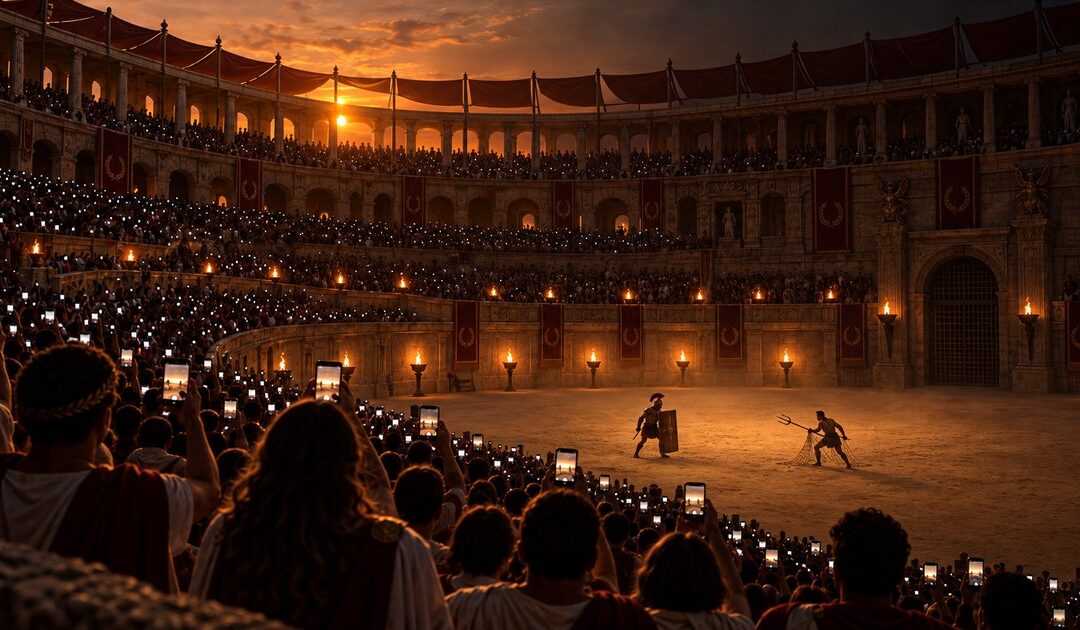
Christians also refused the gladiatorial games and the public spectacles of death that Rome loved. Tertullian wrote an entire treatise warning believers away from them. Athenagoras, writing around 177 AD in his Plea for the Christians, explained that Christians stayed away from the gladiator shows because seeing a man put to death is close to killing him yourself. In the same chapter, he condemns abortion and the abandoning of infants. He saw the arena and the abandoned child as the same problem.
Death was not entertainment, and familiarity with it was not progress.
The same Christian communities cared for the exposed, the sick, and the poor precisely because they saw every person as bearing the image of God. Life was sacred at its beginning and in every condition after: slave or free, strong or weak, guilty or innocent. It belonged to God, and it was not ours to treat lightly.
The death of any person is the loss of one whom God has not treated as disposable.
Where does human dignity come from?
Ephesians 1:5 supplies a deeper reason for that instinct toward life. Paul writes that God “predestined us for adoption to himself as sons through Jesus Christ, according to the purpose of his will.”
Paul was writing into an abandonment culture. Across the Roman world, discarding unwanted babies was commonplace. Archaeologists found a papyrus letter from 1 BC at Oxyrhynchus in Egypt. A working man named Hilarion writes home to his pregnant wife. He’s tender with her. He tells her not to worry and promises to send money as soon as he’s paid. Then, in the same easy tone, he writes: if it’s a boy, keep it; if it’s a girl, throw it out. It reads as casually as a grocery list.
In that same world, adoption was a deliberate legal act. It conferred full status, a new name, and an inheritance. Paul takes that image and says God, according to the good pleasure of His will, takes people who have been otherwise discarded and forgotten and adopts them into His family as sons and heirs.
Which means the dignity of a person is not earned by usefulness, productivity, or moral standing (or political party). It is bestowed on every person by God’s sovereign delight. Each human life carries the weight of that purpose. The death of any person is the loss of one whom God has not treated as disposable.
Why does the Bible call death the last enemy?
Our culture has been teaching us to make peace with death since we were kids. In The Lion King, Mufasa walks young Simba across the Pride Lands and explains the circle of life. In that deep James Earl Jones voice, he tells him everything exists together in a delicate balance, so you have to respect every creature, even the antelope. Simba asks the obvious question. Don’t we eat the antelope? Yes, Mufasa says, but when we die, our bodies become the grass, and the antelope eat the grass. Then the music swells as they sing the circle of life, and we’re supposed to feel warm about it.
That scene has always bothered me a little. I don’t feel warm and fuzzy about it. Because I don’t want to be part of a plan where my final destiny is fertilizer for the next guy. We weren’t made for that to be the end of the story. Something in us rages against that, and Scripture says it should.
Christian tradition has never grown comfortable with death. Paul calls it “the last enemy” (1 Corinthians 15:26), an intruder that entered the world through sin. Grief is an absolutely fitting response. The horror we feel in Erie is not excessive. It is the healthy human reaction to an enemy that has reared its head.
The same gravity belongs to every life, including the lives of innocent children and the lives of condemned criminals. Turning an execution into a widely viewed event, or treating the right to take innocent lives as something to cheer, risks teaching an entire generation that death can be familiar, instructional, or even satisfying.
We do not need to pretend death is “no big deal” in order to have hope. Christ has entered the domain of that last enemy and broken its power. Those of us processing the shock of recent events can keep the shudder, mourn the dead, and look to the One who will one day make death itself die.
The sacredness of life is not a narrow policy claim. It is the recognition that every person is the object of God’s purpose and pleasure, and that the loss of any life should still make us quake.
What can I do this week?
That shudder should move you toward someone. Someone you work with, live near, or coach alongside is grieving right now. By this weekend, write them a card by hand, use the name of the person they lost, and deliver it yourself. Don’t wait until you have the right words.
And if you’re in Erie, you know which street I mean. Pray for the families on Perry Street by name this week.
Derek Sanford has served in pastoral ministry for thirty years and is a pastor at Grace Church in Erie, Pennsylvania. He writes The Ordinary Altar, a weekly letter about bringing faith into the ordinary places you already spend your week. Every Thursday, one reflection and one small practice to try. Get it every Thursday.